Painting Your Art Out Journal
Little Hands, Big Art: Why Painting Matters for Kids
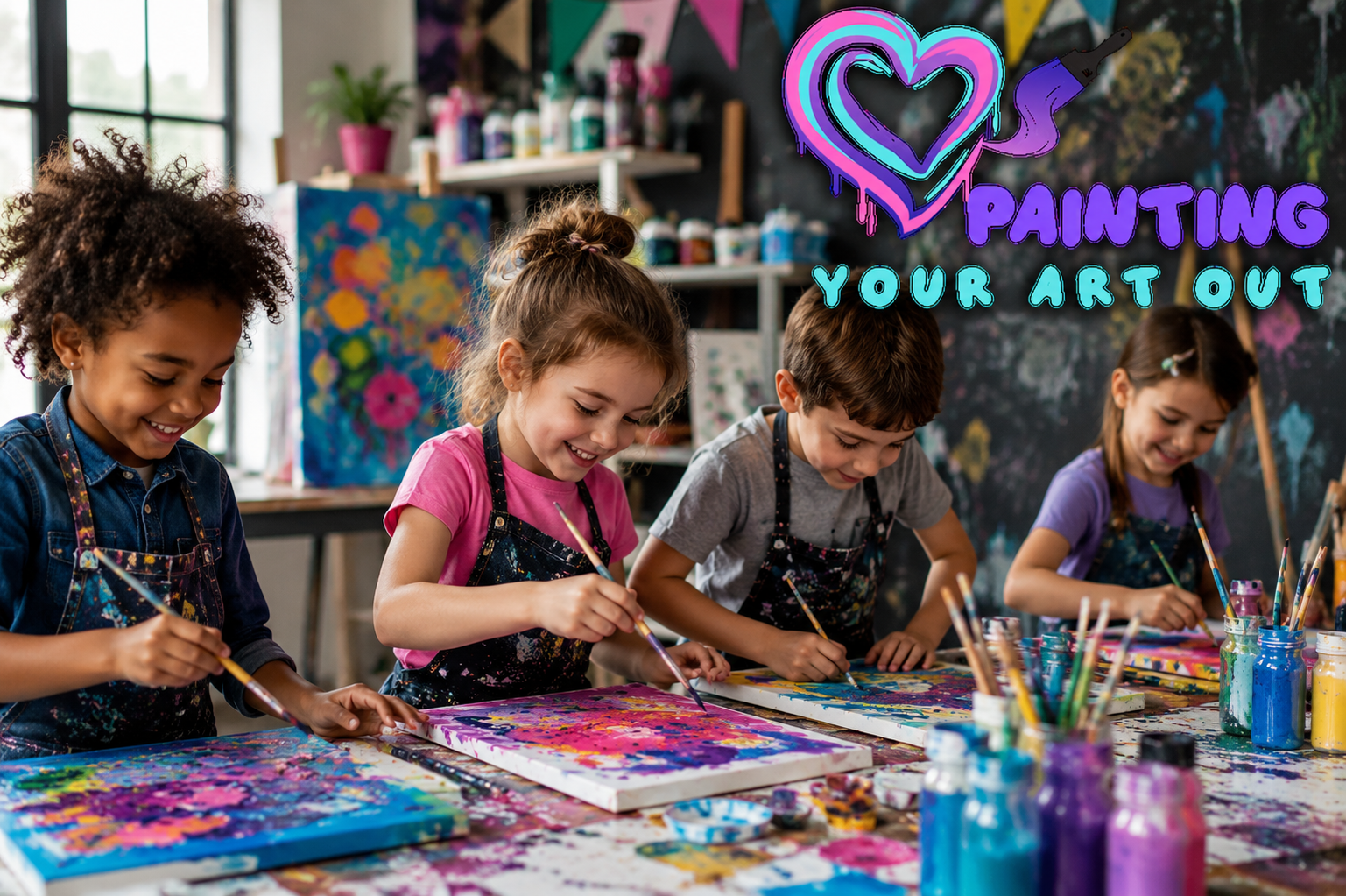
Watch a kid sit down at a blank canvas. They don't pause. They don't second-guess. Armed with a brush, or quite often just their fingers, they dive in. No self-doubt. No rules. That fearless splash of color is more than play. It's one of the most direct forms of self-expression a young mind has.
"Every child is an artist. The problem is how to remain an artist once we grow up." Pablo Picasso
1. A World Without Wrong Answers
Painting is one of the few activities where a kid is truly free. There are no wrong colors. A sky can be green. A sun can be purple. Dinosaurs can wear hats. That freedom matters. It teaches children that their inner world has value and deserves to be expressed.
When kids paint, they learn that creativity isn't about perfection or following instructions. It's about exploring possibilities. Once that lesson sinks in, it shapes how they approach problems, relationships, and challenges for the rest of their lives.
2. How Painting Builds the Creative Brain
Creative activities light up multiple regions of the brain at once. When a child mixes red and yellow to get orange, they're not just playing. They're developing cause and effect reasoning. When they choose which part of the page to paint first, they're exercising spatial thinking and planning.
Over time, regular painting builds what researchers call divergent thinking: the ability to come up with many different solutions to one problem. That's the cognitive engine behind innovation, storytelling, problem-solving, and nearly every creative pursuit a person can have.
What Painting Develops in Kids
Emotional expression. Kids often paint feelings they can't name yet, giving shape and color to big emotions in a safe way.
Fine motor skills. Gripping brushes, controlling pressure, and making precise strokes builds hand-eye coordination.
Color and pattern recognition. Learning colors, mixing them, and noticing patterns lays groundwork for math and science.
Focus and flow. Deep creative engagement teaches kids how to concentrate and settle into calm focus.
3. Painting as Emotional Language
Long before children have the words for complex emotions, they have paint. Art therapists and child psychologists have known for decades that kids use color and image to communicate what words can't reach. Angry red strokes. Soft blue watercolors. Chaotic swirls of black. Each one tells a story.
Letting your child paint when they're happy, sad, excited, or nervous gives them a healthy outlet. It tells them their feelings are valid and can be channeled into something. That's an emotional intelligence lesson that will serve them for life.
4. Confidence That Sticks
When a child finishes a painting, something real happens. They hold something that didn't exist an hour ago. They made it. That sense of authorship, of having created something original, is one of the deepest sources of real confidence a kid can experience.
Unlike a test score, a painting can't be wrong. Putting it on the fridge, in a frame, or up on a shared art wall tells a child: your perspective matters. What you make has worth. That message echoes for years.
This is what we see every time we host a kids paint party in Houston, League City, or Clear Lake. Kids walk in unsure. They walk out holding something they're proud of. Parents tell us their kid still has the painting on their bedroom wall a year later.
5. Tips for Nurturing Your Little Painter
You don't need a studio or expensive supplies. Here's how to make painting a regular, joyful part of your child's life:
Set up a dedicated "art corner." Even a small table with a washable mat tells your child that creativity has a place in your home.
Offer open-ended materials. Watercolors, finger paints, sponges, leaves, crumpled paper. All of it works.
Resist the urge to guide the outcome. Ask "tell me about your painting" instead of "what is this supposed to be?"
Let them mix colors freely. Discovery is the whole point.
Display finished work proudly. A child's gallery wall is worth a thousand words of encouragement.
Paint alongside them sometimes. When kids see adults make things imperfectly and joyfully, they learn that art is for everyone.
If you want to make painting at home easier, our take-home art kits come with everything included. Canvas, paints, brushes, step-by-step guide. No mess to plan. No supplies to hunt down. Just open the box and paint.
For something more memorable, our Mommy & Me paint parties let you create side by side with your little one. Two canvases, one shared memory.
6. The Bigger Picture
In a world shaped by screens and structured curricula, painting offers something rare: unstructured, imaginative, sensory-rich time. It asks nothing of a child except that they show up and play. And in that space of pure play, something good grows.
Kids who paint regularly don't just become better artists. They become more curious, more empathetic, more resilient. They grow up knowing that a blank page is not something to fear. It's something to dive into.
So go ahead. Buy the paint. Spread the newspaper. Hand over the brush. Then step back. What happens next is the whole point.
What would your child paint if you handed them a brush this weekend?
If you're in Houston, League City, Friendswood, Pearland, or the surrounding area and want a no-stress way to give your kids a real painting experience, book a kids paint party or grab a take-home art kit. We bring everything. You just bring the kids.
See upcoming events or contact us to plan your own private party.
Written by Pauline Thomas with first-hand expertise. AI tools may be used for research and drafting assistance, but all content is reviewed, verified, and published by the author.